
The Standard of Attentive Listening
How You Listen Shapes the Quality of Your Relationships
If you watch how most conversations unfold, you’ll notice how often one person interrupts, assumes, and reacts. Listening may be happening, but not in a way that is attentive, captures understanding, and improves the relationship.
Most people would say they listen actively, and many would say they are good at it. Yet people interrupt, sometimes subtly and sometimes overtly. They become visibly distracted. They assume they understand where the thought is going, confidently declaring, “I know what you’re about to say” or finishing the other person’s sentence. And sometimes, they even respond with a complete non sequitur.
What we tend to call listening is often shaped by habit rather than intention. And like most relationship habits, it defaults to what is easiest, not what is effective. If you want a relationship to be the same as it always has been, you can probably get away with your default habits. But if you want better and healthier relationships, you must act differently and with intention. Attentive listening requires both.
ATTENTIVE LISTENING
At its core, I define attentive listening as seeking to understand someone and responding appropriately. It’s an active set of behaviors that is best explained by breaking down the language:
seeking: you show a clear desire, motivation, and intention to listen by deploying your full attention to the other person
understand: that desire is to grasp the meaning of what is being said, both verbally and nonverbally
responding: you avoid the temptation to react (judging, solving, assuming, projecting, concluding, etc.), and instead create space and time for yourself before replying
appropriately: perhaps most important, that thoughtful response is aligned with what the other person might want and/or need
These behaviors are sequential, so the most important steps are the first two, seeking to understand. Without those, it’s virtually impossible to respond appropriately. So how does this work in practice?

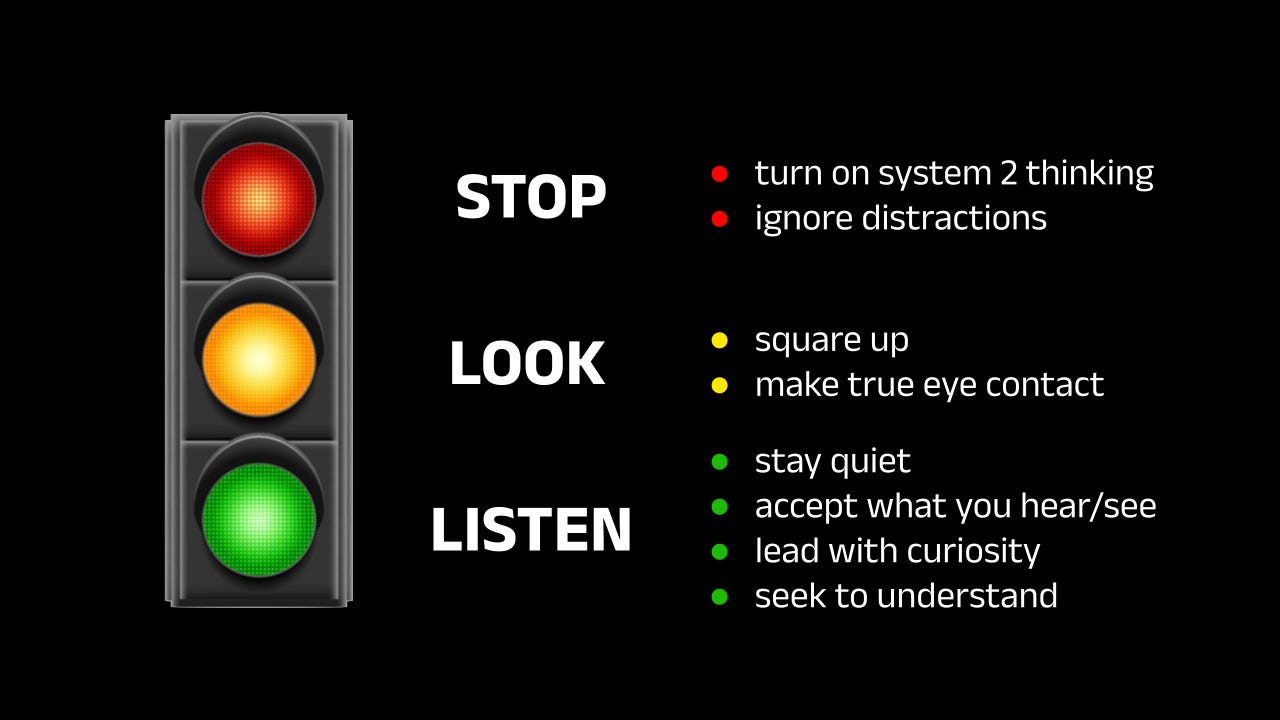
A simple framework called stop, look, listen.
The simplicity of this framework is what makes it memorable and effective, but it also makes it easy to underestimate. Each step requires a heightened level of self-awareness, a capacity for self-control, and intentional behaviors that put the focus on the other person. Together, the three steps form a standard that helps drive attentive listening.
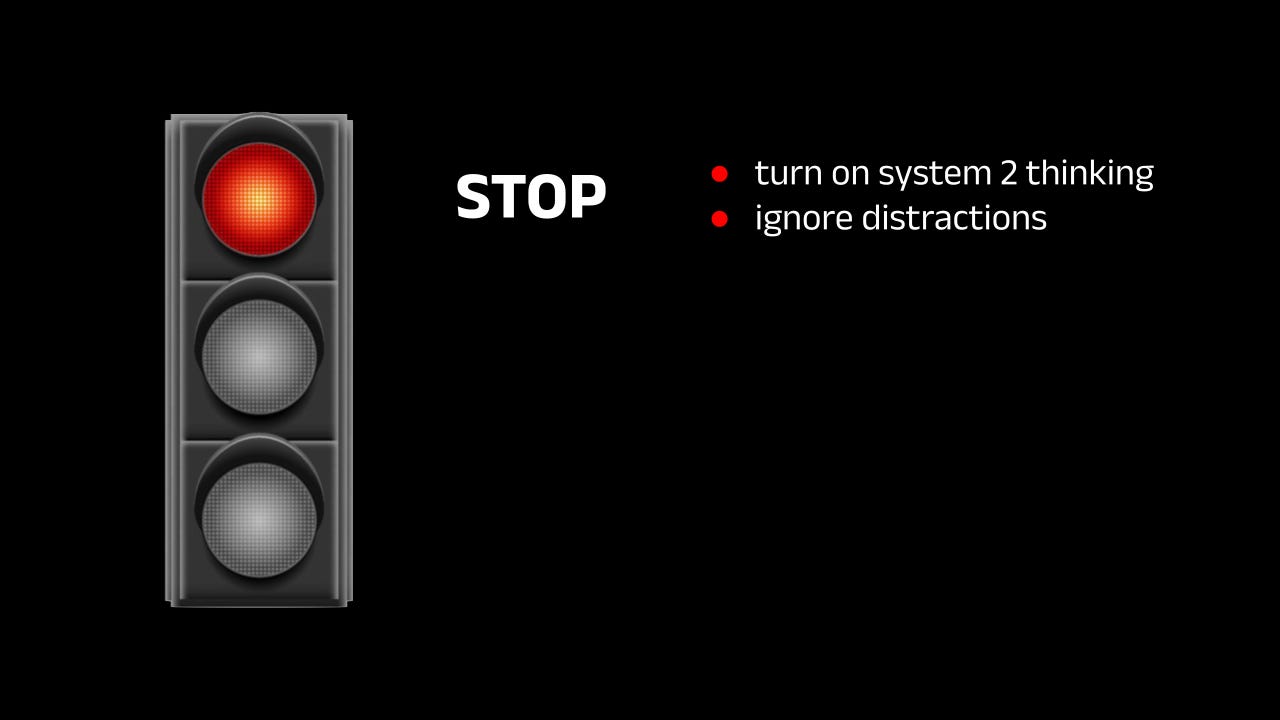
STOP
In most conversations, people are operating in what behavioral scientists refer to as System 1 thinking. This mode of thinking is fast, intuitive, emotional, and largely automatic. It’s always running in the background and cannot be turned off. When we’re listening, it’s what drives quick reactions, interruptions, judgments, conclusions, and assumptions.
Attentive listening requires a shift into System 2 thinking, which is slower, deliberate, logical, and—most importantly—must be turned on. System 2 allows us to become aware of our thinking. When we’re listening, it’s what drives pauses, thoughtful responses, curiosity, and the need to clarify.
When you shift to System 2 thinking, you put yourself in a position to stop whatever you are doing in the moment. Going deeper, that means you’re able to ignore the distractions - internally and externally - that keep you in System 1 thinking.
Internal distractions are intense emotions, curiosities, intrusive thoughts, worries, and physical sensations: your foot fell asleep, you realize you’re madly in love, your friend hasn’t replied to your text, you wonder if you’ll ever get promoted.
External distractions are incoming stimuli of sights, sounds, smells, tastes, and touches: your phone, the screaming child, someone saying your name out loud, a beautiful sunset, the garbage truck you’re stuck behind in traffic.
Both types of distractions get in the way of attentive listening. So when you build the habit to consciously notice that you’re succumbing to them, you’re able to stop and create a pause that allows you to shift from System 1 to System 2, and pay attention to the other person.
LOOK
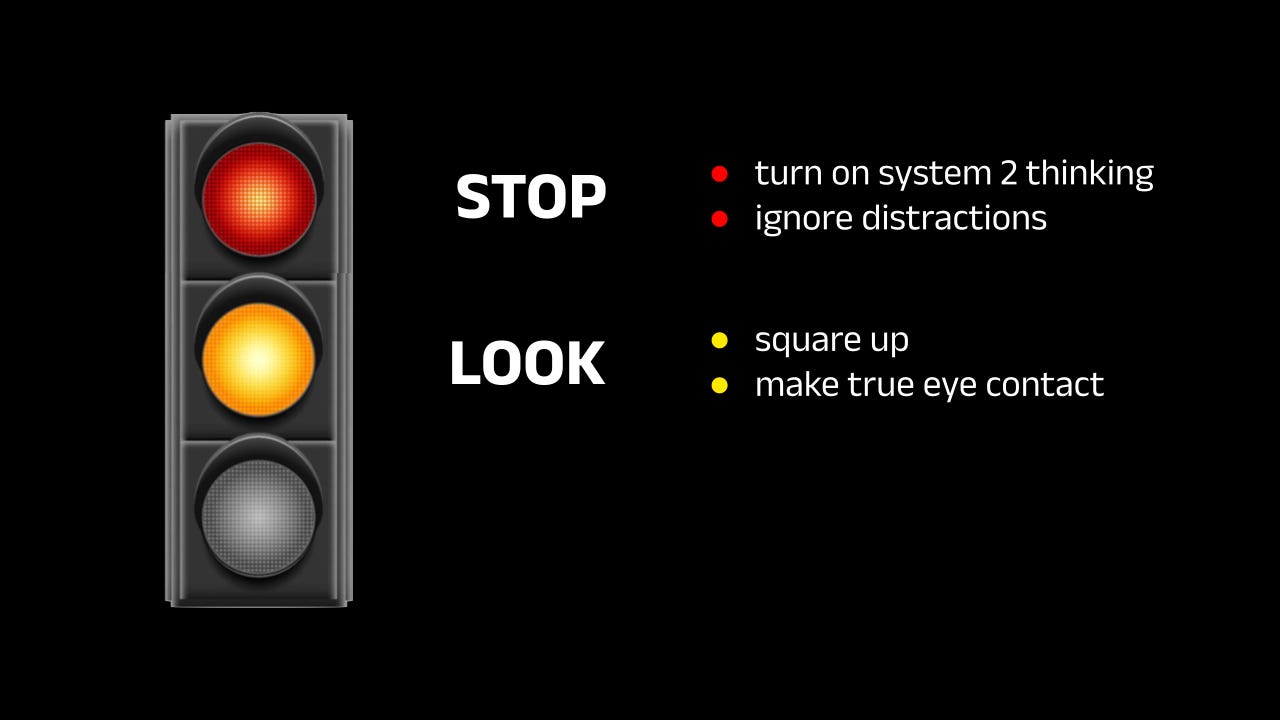
Once you’ve created that pause, the next step is to look. It’s not enough to just be physically present; you have to be visibly engaged in a way that the other person can notice. Looking is about directing your visual, physical, and mental attention fully toward the other person. It is highly intentional and observable by them.
The simplest way to do that is by squaring up. This means aligning your shoulders, hips, and knees with the other person so you can actually look at them. It also includes true eye contact, which involves looking primarily at their eyes and face while also taking in their physical orientation: how they’re squaring up in return, how they’re occupying their private space, and how their body is moving.
If this sounds hard, it’s because it must be done intentionally yet naturally, in a way that doesn’t distract the other person from their own thoughts and what they’re trying to communicate.
These behaviors may seem minor, but they communicate something significant. They signal that you are paying attention, that you are engaged, and that the conversation matters. Effort is visible in relationships, and attention is one of the clearest forms of it.
(On video, the same principles apply but require slight adjustments. Keeping your camera on, centering your head and shoulders within the frame, and using full screen all help maintain focus. Being on video also requires being intentional about where you direct your gaze, shifting between looking at the person on your screen and into the camera to simulate eye contact).
LISTEN
The final step is to listen, which is where most people assume they’re already operating effectively. In reality, this is where much of the work happens.
It begins with staying quiet. This does not simply mean not speaking; it means giving the other person time to complete their thoughts without interruption and resisting the urge to insert your own. You can still support the conversation through nonverbal signals (nodding, smiling, mirroring) or paraverbals (non-word sounds we make when listening, such as um, hah!, ooooh, hmm, uh-uh, and ahhh) without taking control of it.
Using silence enables you to listen at a deeper level. Silent pauses are often awkward for people because they don’t know what they signify, but they can be powerful ways to show that we’re listening attentively. To make them less awkward, you can actually acknowledge that you want to reflect on what they’ve said, tell them you want to digest their thoughts, or simply let out a contemplative sigh or similar paraverbal.
Attentive listening also requires accepting what the other person is saying and expressing. This does not mean agreement, but it does mean allowing their words, perspectives, and emotions to be expressed without judgment or correction (see my article on unconditional positive regard).
“Seek first to understand, then to be understood.” - Stephen R. Covey
Most people move through conversations making quiet assumptions, forming interpretations quickly, and believing they understand more than they actually do. Interpreting and believing are obstacles to attentive listening; understanding and clarity help achieve it.
You can build understanding and clarity in different ways:
Validate what you’re hearing with language such as “sounds like,” “seems like,” or “looks like,” which signals that you aren’t jumping to conclusions or making assumptions about what they mean, and are giving them an opportunity to correct you.
Paraphrase what they have said to check your understanding and whether you are interpreting their words accurately. This can be done by starting with, “If I heard you correctly…” or “So what you’re saying is…” or “Tell me if I understand you correctly…”
Use clarifying questions and statements. This can be done by saying things like, “Tell me more…” or “Can you please clarify…?” or “What do you mean by that?”
These behaviors and language reduce the likelihood of misinterpretation, helping you listen attentively. At the same time, you show curiosity.
Rather than making assumptions or drawing conclusions too quickly, you ask clarifying and open-ended questions that help deepen your understanding and build empathy. This requires staying with the other person’s perspective longer than is comfortable, rather than rushing toward your own. Most people don’t practice this deliberately, and as a result, they default to reacting instead of understanding.
We also return to an advanced level of the looking step while listening. It’s essential to go beyond the other person’s physical orientation to include noticing nonverbal cues such as vocal pace, tone, gestures and movement, pauses, changes in eye contact, as well as paraverbal cues.
Throughout all of this, your orientation remains consistent: you are seeking to understand before responding. That distinction—between listening to respond and listening to understand—may be small in phrasing, but it’s significant in impact. The more you listen to understand, the more empathy you build, the better the conversation is, and the healthier the relationship becomes.
THE STANDARD
Stop, look, listen may seem like a simple standard, but meeting it consistently is not easy because it runs counter to how most conversations naturally unfold.
Active listening asks for something different. It asks you to turn on System 2 thinking when it would be easier to remain in System 1. It asks you to remove distractions when it would be easier to keep them. It asks you to stay quiet when it would be easier to speak. It asks you to observe and clarify when it would be easier to assume. It asks you to put in effort, and the type of effort that is visible to other people.
“Real listening is a willingness to let the other person change you. When you’re giving someone your full attention, listening becomes a form of respect.” - Alan Alda
That willingness is what elevates active listening beyond a technique. It reflects a standard for how you engage with other people. The quality of your relationships is shaped, in part, by the standards you hold, and listening is one of the most visible expressions of those standards.
When you listen this way, the difference is noticeable. People can feel whether you are present or distracted, whether you are waiting or understanding. They can feel whether they are being heard or whether they have to work to be understood. People may not remember every detail of what was said, but they will remember how the interaction felt, and whether they felt understood.
Active listening closes that gap. It improves clarity, reduces misinterpretation, and strengthens the quality of conversations and relationships over time. Relationships deepen not just through frequency of interaction, but through the quality of those interactions, and listening is central to that quality.
And like any standard, its value is not in simply knowing it, but in consistently practicing and meeting it.